Establish Vision (APS01)
Establish Vision (APS01)
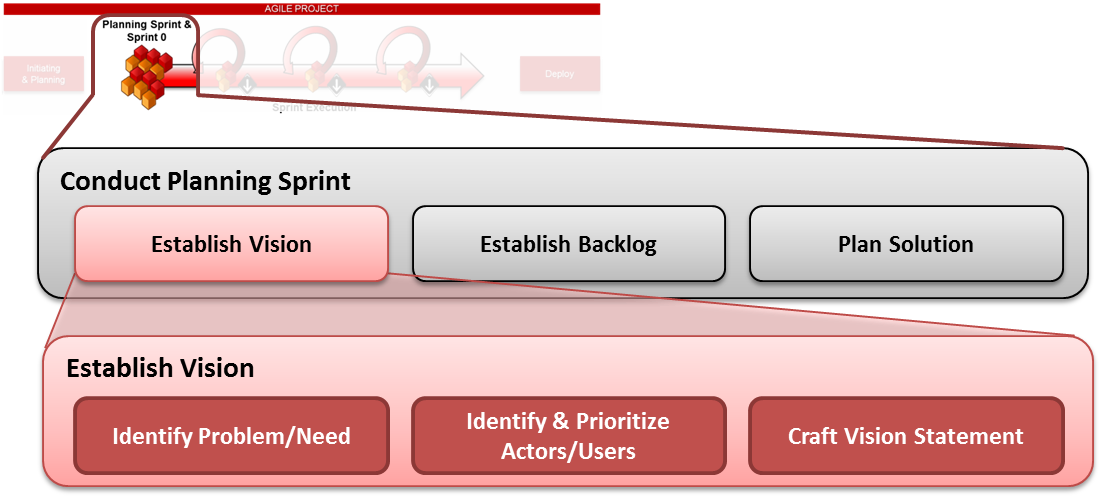
Identify Problem/Need (APS01.1)
|
Description |
The Business Stakeholders, Product Owner, and any other parties with an interest in the system collaborate to clearly establish the business problem, need, or opportunity that the proposed solution will address. This activity then feeds the identification of the main “actors” or users of the solution and also focuses the Vision for the solution, and becomes the basis for measuring the business value of the solution. |
|
Who is Involved |
|
|
Mechanism |
|
|
Frequency |
Once per project/solution, during the Planning Sprint NOTE: Like other backlog items, needs or problems to address can change if business circumstances, priorities, or goals for the solution change during the project. See Refine/Groom Backlog in later sections. |
|
Outcomes |
Should have a brief, concise, easy to understand statement of the business problem, need, or opportunity |
|
Guidelines |
|
Identify & Prioritize Actors/Users (APS01.2)
|
Description |
Identify who will actually be using the system as a solution to the problem/need/opportunity captured in the previous step, and think through their various needs for the solution to enable them to do so. Remember to consider not just basic users, but also potential administrative users. NOTE: Traditional Use Case development can be of assistance here |
|
Who is Involved |
|
|
Mechanism |
|
|
Frequency |
Once per project/solution, during the Planning Sprint NOTE: Like other backlog items, actors and targeted user groups can change if business circumstances, priorities, or goals for the solution change during the project. See Refine/Groom backlog in later sections. |
|
Outcomes |
The project should have a list of primary, secondary, and tertiary target user groups, which is prioritized in terms of the business value obtained from enabling the group and marked for dependencies between groups. This list can then be shared with the UX team for their use in persona generation and other work items. |
|
Guidelines |
|
Craft Vision Statement (APS01.3)
|
Description |
Once the problem/need/opportunity and the various users and actors for the solution are understood, the team should be able to craft a guiding vision for the solution, from which all of the later themes, epics, and user stories in the backlog will be derived. |
|
Who is Involved |
|
|
Mechanism |
|
|
Frequency |
Once per project/solution, during the Planning Sprint NOTE: Like other backlog items, Vision can change if business circumstances, priorities, or goals for the solution change during the project. See Refine/Groom backlog in later sections. |
|
Outcomes |
Should have a brief, concise, easy to understand solution Vision statement that captures the Who, the What, and the Why behind the proposed solution, similar to the following format: “As <stakeholder/project group name>, we want <to achieve some purpose/outcome/goal> so that we <statement about creating some value to the business>.” |
|
Guidelines |
|