Prioritize Solution Backlog (APS08)
Prioritize Solution Backlog (APS08)
|
Description |
All of the known backlog items should be ranked against each other from top-to-bottom in terms of business priority/business value. As the project progresses work items will be selected for sprints based on this prioritization. |
|
Who is Involved |
|
|
Mechanism |
|
|
Frequency |
Once at the beginning of the project, then continuously adjusted during subsequent backlog grooming sessions as project progresses and needs/priorities might change |
|
Outcomes |
The team should have a prioritized backlog with all items ranked from top to bottom |
|
Guidelines |
|
Illustration: Backlog Prioritization
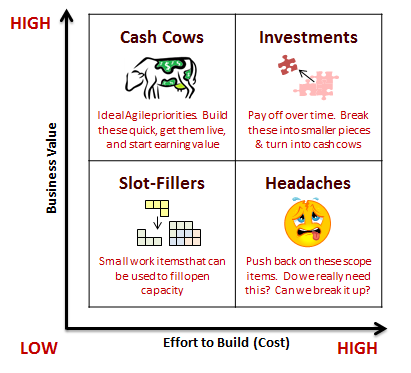
Agile Prioritization & Decision Making
Agile development focuses on maximizing business value as soon as possible. In order to do so, scope items should be prioritized by weighing the business value of the epic or user story (i.e. increased revenue, decreased cost, return on investment, market exposure, etc.) against its cost to develop (i.e., , how much effort is it to create?).
To aid Product Owners in prioritization, they can try to map their scope to the following categories, and prioritize them in order accordingly.
-
Cash Cows – Low Effort/Cost, High Value
These should be the primary focus for Agile delivery. Prioritize these first to enable your team to get a minimum viable solution up and running sooner and then build from there.
-
Investments – High Effort/Cost, High Value
These should be the next focus in Agile, however they need to be refined/broken into smaller pieces to ensure that they can be delivered in single sprints. Is there a way that part of the value proposition from the large item can be realized through a smaller piece? In this way, you can turn investments into cash cows.
-
Slot-fillers - Low Effort/Cost, Low Value
Like in Tetris, Agile teams can encounter situations where there are a few ideal hours or story points of capacity available in a sprint but no high-priority items that would be small enough to fit. This is where small, low effort user stories (1-2 points) come in handy to maximize the value gained in a particular sprint.
-
Headaches - High Effort/Cost, Low Value
Any feature which will have a high cost and effort to build but which cannot be tied to a direct value for the business should be questioned. Is this feature really needed? What is the driver behind this feature? This could be a situation where someone is trying to “gold-plate” a feature, or a situation where a cool idea has not yet found a business case. All agile work items should be understood in light of their potential to generate business value and prioritized (or removed) accordingly.